
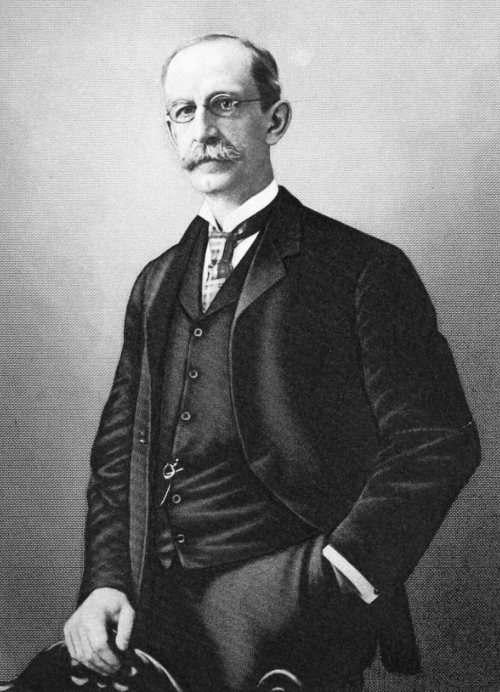
Archibald Murray Howe (May 20, 1848 – January 6, 1916) was and historian and lawyer from Massachusetts.
Biography
Archibald Howe was born on May 20, 1848, in Northampton, Massachusetts. He and his family were the descendants of the Pilgrims who settled Plymouth in 1620. As a child, Howe lived in Brookline, Massachusetts, where he attended a private school. After graduating from Harvard Law School in 1872, Howe served as the private secretary to Henry Pierce, who served as a Republican member of the U.S. House of Representatives from 1873 to 1877. After Pierce left Congress, Howe would serve on the common council in the town of Cambridge, located across the Charles River from Boston.
In the 1884 presidential election, Howe voted for Democrat candidate Grover Cleveland despite being a Republican in the terms of 19th Century politics. Later on, during the Republican presidency of William McKinley, Howe saw the president as an imperialist, especially after the Spanish-American War.
In 1900, Howe joined a coalition of like-minded people to form a new political party at Carnegie Hall in New York called the National Party, which sought to prevent McKinley from getting a second term in that year’s presidential election.
The National Party nominated Donelson Caffery, a former senator from Louisiana, for president, with Howe as his running mate for vice president. However, Caffery, a loyal member of the Democratic Party, refused the nomination. Without a presidential nominee, the National Party collapsed before contesting in the 1900 election, which was ultimately won by McKinley.
During Howe’s lifetime, he spent much of his time researching history. He was also a member of the Massachusetts Reform Club.
In his final years of life, Howe’s mental and physical health declined. On the morning of January 6, 1916, Howe was found by Boston police stumbling around in nightclothes while barefoot. The policemen notices that Howe was covered in blood and they quickly discovered a self-inflicted stab wound in his neck. Archibald Howe died later that same day after being taken to a hospital. He was buried at the Mount Auburn Cemetery in Watertown, Massachusetts. At the time of his death, Howe had been married with a woman named Ann Sergeant since 1881.