
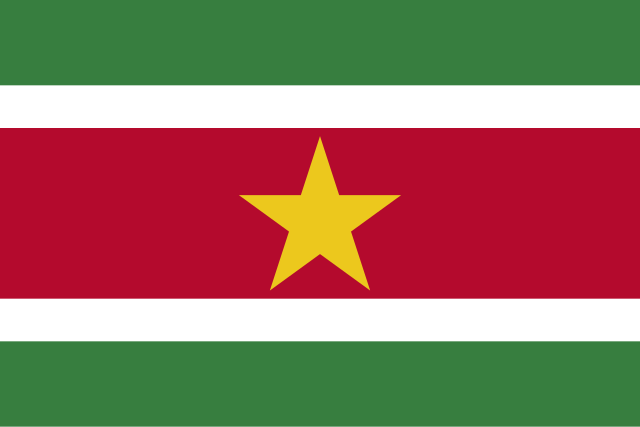
Suriname is a Dutch-speaking country in South America. It borders the Atlantic Ocean to the north, Para to the south, French Guiana to the east, and Guyana to the west. As of 2026, Suriname has a population of 632,638 residents. The capital of Suriname is the city of Paramaribo. Due to the country’s location above the equator, the country has a tropical rainforest climate. Most of Surname’s land is rainforest. As a result, most of the population reside in Paramaribo and the surrounding coastal settlements.
Originally inhabited by various tribes, Suriname was colonized by the Dutch in the 17th century. Prior to 1954, Suriname bore the name Dutch Guiana. It was a plantation that originally relied on African slave labor. When the Netherlands abolished slavery in 1863, the slaves were freed. In order to keep the plantations going, immigrants from China, India, and Indonesia were brought over to Suriname as indentured servants. As of today, most of Suriname’s population is either of African or Asian descent.
After reforms were made by the Dutch colonial administration in 1954, Suriname slowly trekked towards independence. Finally, Suriname proclaimed its independence on November 25, 1975. Following three coups in the 1980s, Suriname was fully democratic by the early 1990s. Today, the country is governed as a presidential republic under a multiple party political system.
As the only independent Dutch-speaking country outside of Europe, Suriname has close ties with the Netherlands. It also closely cooperates with various Caribbean countries. Culturally, Suriname is more closer to the Caribbean than to other South American countries. It is a part of the United Nations and the Organization of American States. The country has a developing economy that is extremely reliant on resource extraction. Suriname’s most important resources include bauxite, petroleum, and gold. Its economy, despite being small, is high on the Human Development Index. Since 2004, Suriname has used the Suriname dollar as its currency.