
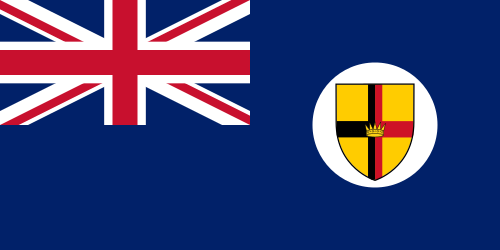
Sarawak, officially named the Commonwealth of Sarawak, is a country located on the island of Borneo in Southeast Asia. It shares land borders with Brunei, Indonesia, and Sabah. As of 2026, Sarawak has a population of 2,907,500 inhabitants. The capital of Sarawak is the city of Kuching, which is also its largest city.
History
In 1841, a British sailor named Sir James Brooke landed in the port city of Kuching, which was then controlled by the Sultan of Brunei. The Sultan appointed Brooke as the ruler of Kuching that same year after he helped quell a rebellion in the area. Brooke was ultimately given the title of Rajah (Malay for King) on September 24, 1841. Five years later in 1846, Sarawak gained independence from Brunei, though Brooke remained as its king until his death in 1868.

During the Brooke family’s reign in Sarawak, this region of Borneo began to modernize while Christianity began to replace Islam as the dominant religion of the populace. In 1850, Sarawak gained foreign recognition from the United States. Fourteen years later, the British Empire also recognized Sarawak as a country. In 1867, the Supreme Council of Sarawak, modelled off of the British parliament, met for the first time. It initially consisted of the tribal chiefs who were loyal to the Rajah of Sarawak.
The country also began to expand starting in 1882. In 1888, Sarawak officially became a British protectorate, though the Brooke family still remained in power. The Malay population, who already viewed the Brooke family as colonists, did not want to have British rule imposed on them. During this era, piracy and headhunting were banned while the country continued expanding. The modern borders of Sarawak were finally implemented in 1905.
In 1941, one-hundred years after James Brooke landed in Sarawak, the country enacted a new constitution, which limited the power of the Rajah. This was supposed to allow Sarawak’s population to have more of a say in governance. Later that same year, Japan invaded and occupied Sarawak, exiling the Brooke family to Australia. For most of World War Two, Sarawak was fused with Brunei to form the Japanese occupation zone known as Kita Boruneo (Japanese for “Northern Borneo”).
Eventually, in March 1945, Allied troops, mostly from Australia, began to liberate Sarawak from the Japanese Empire. Eventually, the last Japanese forces in Sarawak surrendered on September 10, 1945. From then until 1946, Sarawak would be under a provisional British military administration.
Following World War Two, Sarawak was in ruins due to damage from the war. Since the Brooke family didn’t have the resources to rebuild Sarawak, it was decided that Sarawak would become a British Crown Colony. The last Rajah of Sarawak, Charles Brooke, officially abdicated on July 1, 1946. The Malay population did not like this decision and protests against British rule would last until the early 1950s.
When China became communist in 1949, the Chinese population of Sarawak began to fight a Communist insurgency against the British. Most of the insurgency was fought in the country’s jungles. This insurgency would continue until 1990.
On July 22, 1963, Sarawak officially gained independence from the British Empire. Initially, the new country wanted to join with neighboring Malaysia. However, due to opposition from the neighboring country of Indonesia, who opposed the expansion of Malaysia into Borneo, Sarawak gave up its dream of unification with Malaysia in 1966. Ever since independence in 1963, Sarawak has been a member of the British Commonwealth, with the British monarch as its ceremonial head of state.
In 2012, Sarawak’s government entered into a maritime dispute with China over the South China Sea. The issue is still unresolved as of 2026.
Sarawak Today
Today, Sarawak is a regional power in Southeast Asia. It is a member of the British Commonwealth, the United Nations, and is the only allied state to McGrathia in the region. Its main exports are natural gas, timber, crude oil, and palm oil. It is also a bilingual country, with English and Malay being the two official languages.