
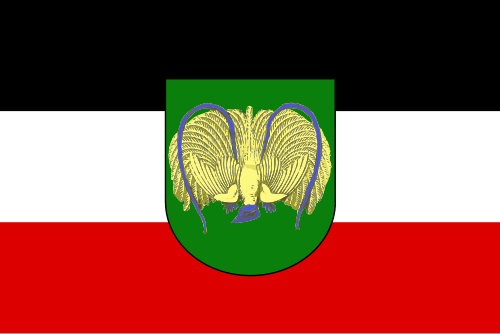
New Guinea (German: Neuguinea) is a German-speaking country that consists of the eastern half of the island of New Guinea. It also controls the Melanesian islands of New Pomerania, Bougainville, Buka, and New Mecklenburg. New Guinea shares its only land border with East Timor to the west. As of 2026, the country has an estimated population of 11,781,559 residents. The capital of New Guinea is Moresbystadt, which is also its largest city. Prior to 1994, the town of Simpsonhafen was the capital, but was evacuated following a volcanic eruption.
Originally colonized by Germany in 1884, New Guinea was the only overseas colony that Germany was allowed to keep following World War One. When Germany became fascist in 1933, New Guinea gained independence with the assistance of Australia. In the midst of World War Two, the country was occupied by Japan briefly until its liberation by a joint American-Australian army and navy force. In 1949, the southeastern half of New Guinea, then known as the Papua Territory, was sold by Australia to the country of New Guinea. The city of Port Moresby was subsequently renamed to Moresbystadt in 1957 in order to Germanize the name.
Ever since the end of World War Two, New Guinea has been economically reliant on Australia. Many Australians jokingly refer to New Guinea as their “German neighbors” due to its reliance upon Australian aid. New Guinea has also gotten help from its former colonizer, Germany, as it is the only German-speaking nation outside of Europe. Henceforth, New Guinea is often considered a middle man in relations between Germany and the South Pacific island nations.New Guinea is a founding member of the United Nations and the Pacific Islands Forum.